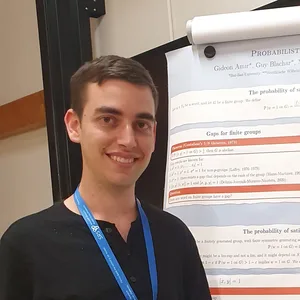
Guy Blachar
I am a mathematician working at the interface of probability and algebra. My interests include random walks on groups, random polynomials, probabilistic methods in algebra, and the structure theory of rings and algebras.
Currently, I am a postdoc at Université Paris Dauphine–PSL, working with Prof. Justin Salez. Previously, I was a postdoc at the Weizmann Institute of Science with Prof. Gady Kozma. I did my PhD at Bar-Ilan University under the supervision of Prof. Gideon Amir and Prof. Uzi Vishne.
Publications and Preprints
Click a paper title to read its abstract.
Papers
- arXiv
The speed of random walks on semigroups
We construct, for each real number $0\leq \alpha\leq 1$, a random walk on a finitely generated semigroup whose speed exponent is $\alpha$. We further show that the speed function of a random walk on a finitely generated semigroup can be arbitrarily slow, yet tending to infinity. These phenomena demonstrate a sharp contrast from the group-theoretic setting. On the other hand, we show that the distance of a random walk on a finitely generated semigroup from its starting position is infinitely often larger than a non-constant universal lower bound, excluding a certain degenerate case.
(with Be'eri Greenfeld), to appear in Annales de l'Institut Henri Poincaré (2026). - arXiv Journal
Probabilistic laws on infinite groups
We study the probability that certain laws are satisfied on infinite groups, focusing on elements sampled by random walks. For several group laws, including the metabelian one, we construct examples of infinite groups for which the law holds with high probability, but the group does not satisfy the law virtually. On the other hand, we show that if an infinite group satisfies the law $x^2=1$ with positive probability, then it is virtually abelian.
(with Gideon Amir, Maria Gerasimova and Gady Kozma), Israel Journal of Mathematics, 1–56 (2026). - arXiv Journal
Mixability of finite groups
Say that a finite group $G$ is mixable if a product of random elements, each chosen independently from two options, can distribute uniformly on $G$. We present conditions and obstructions to mixability. We show that $2$-groups, the symmetric groups, the simple alternating groups, several matrix and sporadic simple groups, and most finite Coxeter groups, are mixable. We also provide bounds on the mixing length of such groups.
(with Gideon Amir, Subhajit Ghosh and Uzi Vishne), Random Structures & Algorithms 67, no. 4: e70037 (2025). - arXiv Journal
Rank-stability of polynomial equations
Extending the thoroughly studied theory of group stability, we study Ulam stability type problems for associative and Lie algebras; namely, we investigate obstacles to rank-approximation of almost solutions by exact solutions for systems of polynomial equations. This leads to a rich theory of stable associative and Lie algebras, with connections to linear soficity, amenability, growth, and group stability. We develop rank-stability and instability tests, examine the effect of algebraic constructions on rank-stability, and prove that while finite-dimensional associative algebras are rank-stable, ‘most’ finite-dimensional Lie algebras are not.
(with Tomer Bauer and Be'eri Greenfeld), International Mathematics Research Notices, 2025.13 (2025). - arXiv Journal
A law of iterated logarithm on lamplighter diagonal products
We prove a Law of Iterated Logarithm for random walks on a family of diagonal products constructed by Brieussel and Zheng (2021). This provides a wide variety of new examples of Law of Iterated Logarithm behaviours for random walks on groups. In particular, it follows that for any $\frac{1}{2}\leq \beta\leq 1$ there is a group $G$ and random walk $W_n$ on $G$ with $\mathbb{E}|W_n|\simeq n^\beta$ such that $$0<\limsup \frac{|W_n|}{n^\beta(\log\log n)^{1-\beta}}<\infty$$ and $$0<\liminf \frac{|W_n|(\log\log n)^{1-\beta}}{n^\beta}<\infty.$$
(with Gideon Amir), Groups, Geometry, Dynamics 19, no. 3, pp. 1041–1080 (2025). - arXiv Journal
Lipschitz harmonic functions on vertex-transitive graphs
We prove that every infinite, locally finite vertex-transitive graph $G$ admits a non-constant Lipschitz harmonic function.
(with Gideon Amir, Maria Gerasimova and Gady Kozma), Electronic Communications in Probability, 29, 1–4 (2024). - arXiv Journal
Semiassociative algebras over a field
An associative central simple algebra is a form of matrices, because a maximal étale subalgebra acts on the algebra faithfully by left and right multiplication. In an attempt to extract and isolate the full potential of this point of view, we study nonassociative algebras whose nucleus contains an étale subalgebra bi-acting faithfully on the algebra. These algebras, termed semiassociative, are shown to be the forms of skew matrices, which we are led to define and investigate. Semiassociative algebras modulo skew matrices compose a Brauer monoid, which contains the Brauer group of the field as a unique maximal subgroup.
(with Darrell Haile, Eliyahu Matzri, Edan Rein and Uzi Vishne), Journal of Algebra, 649, 35–84 (2024). - Chapter
Identities of the algebra $\mathbb{O}\otimes\mathbb{O}$
We find nonassociative polynomial identities of minimal degree, which is $7$, for the algebras $\mathbb{O}\otimes\mathbb{O}$ and $M_2(\mathbb{O})$, where $\mathbb{O}$ is the octonion algebra.
(with Louis Rowen and Uzi Vishne), Algebra and Coding Theory, Contemporary Mathematics 785, 35–45 (2023). - Journal
Abelianization of the Cartwright-Steger lattice
The Cartwright-Steger lattice is a group whose Cayley graph can be identified with the Bruhat-Tits building of $\mathrm{PGL}_d$ over a local field of positive characteristic. We give a lower bound on the abelianization of this lattice, and report that the bound is tight in all computationally accessible cases.
(with Orit Sela–Ben-David and Uzi Vishne), Algebra and Discrete Mathematics, Vol. 34(2), 176–186, (2022). - Journal
Noncommutative inclusion–exclusion, representations of left regular bands and the Tsetlin library
We find a semigroup $Q_n$, whose category of partial representations contains the representation category $\operatorname{Rep}(F_n)$ of the free left regular band $F_n$. We use this to construct a resolution for the absolute kernel of a representation of $F_n$, for which the kernel $\mathrm{Sp}_n$ of the Markov operation in the Tsetlin library model is a prominent example. We obtain a formula for the dimension of the absolute kernel, generalizing the equality of the dimension of $\mathrm{Sp}_n$ to the number of derangements of order $n$.
(with Louis Rowen and Uzi Vishne), International Journal of Algebra and Computation, Vol. 31(1), 37–62, (2021). - Chapter
$\ell$-weak identities and central polynomials for matrices
We develop the theory of $\ell$-weak identities in order to provide a feasible way of studying the central polynomials of matrix algebras. We describe the weak identities of minimal degree of matrix algebras in any dimension.
(with Eliyahu Matzri, Louis Rowen and Uzi Vishne), Polynomial Identities in Algebras, Springer INdAM Series 44, 69–95 (2021).
Preprints
- arXiv
Cutoff on abelian groups
We prove the long-predicted equivalence between the cutoff phenomenon and the product condition along any sequence of abelian random walks whose inverse transition probabilities grow at most logarithmically with the size of the group. Our result does not require reversibility, and comes with a sharp quantitative estimate on the mixing window. Moreover, we show that our sparsity restriction is optimal by constructing abelian Cayley graphs which satisfy the product condition but fail to exhibit cutoff, and whose degrees are arbitrarily close to being logarithmic in the volume.
(with Jonathan Hermon and Justin Salez), submitted. - arXiv
Random semigroups à la Gromov
We introduce a model of random semigroups analogous to Gromov's density model for random groups. For a fixed number $n\ge 2$ of generators and a density parameter $\delta\in (0,1)$, we impose a uniformly chosen set of $\lfloor n^{2\delta l}\rfloor$ relations of the form $u=v$, where $u,v$ are distinct words of length at most $l$, and study the resulting semigroup as $l\to\infty$. We prove that, with overwhelming probability, above density $1/2$ the semigroup is trivial, while below density $1/2$ it contains a free subsemigroup of rank two, has a Golod-Shafarevich semigroup algebra over every field, and has a homomorphic image which generates a non-elementary hyperbolic group. We also show that the small cancellation condition $C(m)$ holds with overwhelming probability whenever $\delta<1/(2m)$. Finally, for $n\ge 3$, at critical density $1/2$ we obtain a subsequential limiting distribution on finite semigroups, with positive mass at the trivial semigroup and unbounded support in size. This contrasts with random groups, which have order at most two with overwhelming probability at critical density.
(with Be'eri Greenfeld and Margaret Shideler), submitted. - arXiv
Galois groups of random polynomials of large degree
We study random polynomials of the form \[R(x)=x^n+\omega_{n-1}x^{n-1}+\cdots+\omega_0,\] where $\omega_0,\dots,\omega_{n-1}$ are independent, uniformly bounded integer-valued random variables, and $\omega_1,\dots,\omega_{n-1}$ have a fixed common law $\mu$.
We prove (unconditionally) that, if the Rényi entropy of order $2$ satisfies $H_2(\mu)=-\log\|\mu\|_2^2>12$, then \[\mathbb{P}(\operatorname{disc}(R)\text{ is a square})=O_\mu(1/\log n).\] Combined with previous results, this shows that, for such measures $\mu$ and under additional hypotheses, $R$ has full Galois group $\mathrm{Sym}(n)$ with high probability, when conditioned on $\omega_0\ne 0$.
(with Emmanuel Breuillard and Gady Kozma), submitted. - arXiv
Edge-regular graphs with non-negative curvature have polynomial growth
A long-standing conjecture in the emerging discrete Bakry-Émery theory asserts that bounded-degree graphs satisfying $\mathrm{CD}(0,\infty)$ have polynomial growth. In the present paper, we prove this conjecture for all edge-regular graphs, and even obtain a volume doubling estimate with a constant that depends only on the degree. This is made possible thanks to the discovery of a surprising self-improvement phenomenon, which seems of independent interest: any edge-regular graph satisfying $\mathrm{CD}(\kappa,\infty)$ for some $\kappa\in\mathbb R$ must in fact satisfy $\mathrm{CD}(\kappa,n)$ for some explicit, universal and optimal dimension parameter $n$.
(with Hervé Pajot and Justin Salez), submitted. - arXiv
Small entropy doubling for random walks and polynomial growth
Gromov's theorem states that a finitely generated group has polynomial growth if and only if it is virtually nilpotent. A key ingredient in its proof is the small doubling property. In this work, we study entropy analogues of this property for random walks on groups. We show that if a finitely supported symmetric random walk $R_n$ satisfies \[ \mathrm{H}(R_{2n}) \le \mathrm{H}(R_n) + \log K \] at some sufficiently large scale $n$, then the underlying group is virtually nilpotent, with bounds depending on $K$ and $\mu_{\min}$.
Our approach adapts Tao's entropy Balog–Szemerédi–Gowers argument to unimodular locally compact groups, combined with structural results on approximate groups.
As applications, we obtain entropy-based criteria for polynomial growth. We also deduce an entropy gap phenomenon: if $G$ is not virtually nilpotent, then the entropy of random walks on $G$ grows faster than a universal superlogarithmic function.
submitted. - arXiv
Phase transition for recurrence of stationary random walks on lamplighter groups
We introduce and study a class of random walks on lamplighter groups $H\wr G$, where $H$ is a nontrivial finitely generated group and $G$ is an infinite finitely generated group, called stationary random walks. At each step, the walk switches the lamp at its current position, moves in the base group with a drift towards the identity, and switches the lamp again at the new position. We show that when $G$ is virtually-$\mathbb{Z}$ and $H$ is finite, these walks exhibit a phase transition between recurrence and transience, while when $G$ is not virtually-$\mathbb{Z}$ or $H$ is infinite, they are always transient. In the case $G=\mathbb{Z}$, we determine the exact critical parameter and provide a quantitative description of this phase transition.
(with Itai Benjamini and Ariel Yadin), submitted.
Software
- SageMath interface to the GAP package GBNP Code(with Tomer Bauer).
Teaching
Instructor:
- Linear Algebra I (Summer 21, 22, 23, 24)
- Introduction to Probability and Statistics for Financial Mathematics (Fall 23)
TA:
- Linear Algebra I (Fall 16)
- Introduction to Probability and Statistics (Spring 21, 22) · TA notes in Hebrew (PDF)
- Group Theory (Fall 22, 23, 24)
- Rings and Modules (Spring 21, 23)
- Fields and Galois Theory (Fall 22, 23, 24)
- Mathematical Probability (Spring 21, 22, 23, 24) · TA notes in Hebrew (PDF)
- Algebraic Structures for Computer Science (Fall 16, Spring 24)
Conferences
Here are some conferences I helped organize:
- AI and Mathematics: Current Trends and Future Directions (September 2024).
- Formal Power Series and Algebraic Combinatorics (FPSAC 2021) (January 2022).